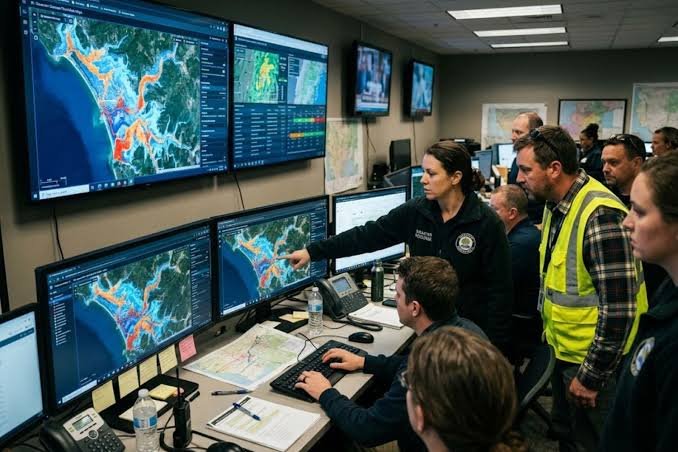

Artificial intelligence systems fuse remote sensing data, on-site imagery, and contextual metadata to quantify disaster damage. They translate pixels into structured metrics, embedding geospatial and temporal context for reproducibility and auditability. Beyond assessment, AI projects needs, optimizes resource use, and supports scenario planning through heterogeneous data integration. The approach hinges on rigorous validation, governance, and ethics to balance speed with equity and accountability, inviting careful scrutiny as stakeholders seek dependable, transparent outcomes.
What AI Tools Read the Damage Scene
AI systems read the damage scene through a combination of remote sensing data, on-site imagery, and contextual metadata to quantify impairment and prioritize response. In this framework, tools perform damage localization by correlating spatial patterns with structural indicators, while sensor fusion reconciles heterogeneous signals into a coherent assessment. This interdisciplinary approach supports rapid, autonomous triage and informed resource allocation.
From Pixels to Impact: Measuring Damage With Imagery
From pixels to consequence, imagery serves as the primary quantitative bridge between observation and measured impact, translating visual evidence into structured damage metrics. This approach integrates geospatial context, temporal sequences, and sensor calibration to produce reproducible impact metrics.
Data provenance governs reliability, enabling cross‑validation and audit trails, while interdisciplinary methods ensure transparent inference about damaged infrastructure, housing, and ecosystem services.
Beyond Maps: AI for Needs Forecast and Resource Allocation
The shift from measuring damage through imagery to forecasting needs and guiding resource distribution builds on the quantified impact framework established earlier. AI enhances needs forecast by integrating heterogeneous data streams, enabling proactive prioritization and scenario planning. Interdisciplinary methods align logistics, equity, and operational constraints, refining resource allocation while preserving transparency and adaptability for diverse stakeholders in rapidly evolving disaster landscapes.
Ensuring Trust: Validation, Ethics, and Limitations in AI Damage Assessments
Ensuring trust in AI-driven damage assessments hinges on rigorous validation, explicit ethical guardrails, and a clear articulation of inherent limitations.
The analysis integrates technical rigor with social science, highlighting validation ethics as a framework for cross-disciplinary accountability.
Transparency about limitations fosters decision-maker autonomy and public confidence, while continuous calibration mitigates bias, misclassification, and overreach.
Responsible deployment demands ongoing evaluation and interdisciplinary governance.
Frequently Asked Questions
How Do AI Systems Handle False Positives in Damage Detection?
False positives are mitigated by threshold tuning and cross-validation, ensuring calibrated confidence levels; systems iteratively adjust sensitivity, corroborate with multi-modal data, and report uncertainty, balancing rapid assessments with credible verification for stakeholders seeking autonomous yet responsible insights.
What Role Do Humans Play Alongside AI in Assessments?
“Put the cart before the horse”—humans collaborate with AI in assessments, providing human oversight to validate outputs and interpret context. The approach emphasizes ethical deployment, interdisciplinary analysis, and freedom to question assumptions within a meticulously grounded framework.
Can AI Predict Long-Term Recovery Timelines After Disasters?
AI can offer predictive timelines and recovery forecasting, yet uncertainties persist; outcomes depend on data quality, governance, and social factors, requiring meticulous cross-disciplinary analysis to form actionable, transparent guidance for stakeholders seeking informed, autonomous decision-support.
How Is Privacy Protected in Image Data Used for Damage Checks?
Disaster assessment ethics stipulates privacy safeguards and image anonymization; data minimization limits exposure, while rigorous governance ensures consent and oversight. Analysts appraise risk, balancing utility and rights, enabling responsible, transparent use of image data for damage checks.
What Are Costs and Accessibility Barriers to Adopting AI Tools?
Costs and accessibility barriers to adopting AI tools include significant upfront investments, ongoing maintenance, and specialized talent, while data access constraints and interoperability issues hinder rapid deployment across diverse disaster contexts. Analysts emphasize cost barriers and data access in planning.
See also: How Artificial Intelligence Is Used in Smartphones
Conclusion
Artificial intelligence, when applied to disaster damage assessment, integrates diverse data streams into an auditable evidentiary chain—from pixels to impact. It enables rapid triage, needs forecasting, and resource optimization while preserving accountability through validation and governance. Yet, the system’s power hinges on data quality, equity considerations, and transparent ethics. The conclusion is a cautioned miracle: like a compass calibrated by humanity, AI points toward relief but must be held to the terrain of trust, oversight, and continual refinement.